Thursday, March 30, 2017

Prediction of impacts

PREDICTION OF IMPACTS

An interdisciplinary approach helps in evaluating the impacts of an activity on the potential consequences that may be:
  1. Long-term or short-term
  2. Direct and indirect
  3. Secondary, individual and cumulative
  4. Beneficial and adverse
Environmental issues are interdisciplinary, interactive, biological and probablilistic. Indirect or secondary effects can be ignored as they are distant with regard to time from the actual proposed project. Impact prediction and assessment is a major step in environmental assessment process. It involves projection of environmental setting in the future without the proposed action and predicting the impact and assessing the consequences.
The possible changes in the various components of the environment are predicted below:
  • Air - degradation due to emissions released and their effect on human beings and the surroundings. Effects of excessive noise due to the project
  • Water - degradation of the quality of water and its effect on aquaculture potential and aesthetics of the ecosystem, depletion of groundwater, pollution of nearby water-body by hazardous and toxic substances, effect of temperature and siltation capacity.
  • Solid waste - Excess generation of solid wastes cause stress on existing environment
  • Vegetation - Destruction of forest cover, depletion of cultivable land, changes in biological productivity, changes in species diversity and rapid disappearance of important species.
  • Energy & natural resources - Impact on energy sources in the area due to thermal power generation, natural gas consumption and their effect on local natural resources.
  • The action of natural disasters like floods, Earthquake, depositions, stability and air movements.
  • Effects on soil and local geology in the form of changes in their physico-chemical characteristics along with an effect on the stability of soil.
  • Adverse effects due to man-made facilities and activities like built structures, utility networks, transportation and waste disposal
  • Disruption in food chain and spread of diseases due to vectors.
Human aspects affected due to project activities are listed below:
  • Economical and occupational aspects involve displacement of population, reaction of population to employment opportunities, services and distribution patterns and change in property values
  • Social pattern is affected due to resettlement, rural migration, population density, food, housing, material goods. Another factor to be considered in social pattern is  type of living which can be nomadic or settled, pastoral clubs, recreation, rural or urban lifestyle.
  • Social amenities and relationships that are affected by project activities include: family life style, schools, transport, community feelings, disruptions, language spoken, hospitals, clubs and neighbours
  • Psychological features include involvement, expectations, stress, work satisfaction, challenges, national or community pride, freedom of chores, company or solution, mobility
  • Physical amenities include national parks, wildlife, art galleries, museums, beauty, landscape, wilderness, quiet, clean air and water
  • Health includes established medical standards and availability of medical services
  • Personal security refers to freedom from molestation and natural disasters
  • Regional and traditional belief refers to symbols, values and taboos
  • Technology refers to security hazards, safety measures and decomissioning of wastes, congestion and density
  • Cultural aspects refer to leisure, fashion and new values
  • Political aspects refer to authority, decision making and resource allocation
  • Legal aspects are restructuring administrative management, changes in taxes and public policy
  • Aesthetic aspects could be visual physical changes, moral conduct and sentimental values
  • Statutory laws refer to air and water quality standards, nation building acts and noise abatement bye-laws.

Wednesday, March 29, 2017

Control of SPM by equipment (gravitation, centrifugation, filtration, scrubbing, electrostatic precipitation)

CONTROL OF SUSPENDED PARTICULATE MATTER BY EQUIPMENT
Suspended Particulate Matter is a collective name given to fine liquid or solid particles added to the atmosphere by processes in the Earth's surface. A few examples of particulate matter are dust, soot, smoke, fumes, mist, pollen, soil particles, etc. SPM may be further classified into RSPM and TSPM based on the average size of particles.
RSPM refers to Respirable Suspended Particulate Matter and it is of size small enough to enter the respiratory tract of human beings and damage the lungs. The average size of RSPM is of the order of 0.1 microns or less.
Particulate matter generates from natural sources like volcanoes, salt sprays, dust storms, grassland fires and living vegetation. Man made sources of SPM is primarily burning of fossil fuels for vehicles, operation of power plants, industrial operations and coal combustion for heating homes and supplying energy.
The composition of SPM depends upon the source. Wind blown mineral dust is composed of mineral oxides and other material blown from Earth's crust. Sea salt is composed of NaCl originates from sea spray.Salt sprays from sea reflect  the composition of sea water and may contain chlorides and sulphates of Magnesium and Potassium. Secondary particles are derived from oxides of primary gases like oxides of Sulphur and Nitrogen. Organic matter may be primary (from anthropogenic or biogenic activities) or secondary (from oxidation of VOCs).
Secondary Organic Aerosols (SOAs) emitted due to internal combustion engines are a danger to human beings.
Control of SPM can be achieved by the equipment listed below.

  1. Control of SPM by gravitation 
Equipment used: Gravitational Settling Chamber A typical gravitational chamber is shown below.


  • The dust laden gas enters at the inlet and due to the sudden increase in cross-section the particulate matter settles at the bottom and can be removed from the dust hoppers as shown
  • The clean gas free from particulate matter exits  from the outlet
IMPORTANT FACTS:
  • Simple to construct and maintain
  • Efficient to remove particles of diameter greater than 50 mm from gas streams
  • They are used as pre-cleaners before passing gases through high efficiency collection devices
  • They rely on gravitational settling and are the simplest and oldest mechanical collectors for removal of particulates from gas streams
  • Flow within the chamber must be uniform without macroscopic mixing
  • Dust removal system must be sealed to prevent production of turbulence due to air from leaking into chamber
  • Efficiency of the equipment increases with increased residence time of the waste gas. Hence, the equipment is operated at lowest possible gas velocity
  • The size of the unit depends on:
    • gas velocity which should preferably be less than 0.3 m/s
ADVANTAGES
  • Low capital and energy cost
  • Low maintenance and operating costs
  • Low pressure drop
  • Reliable
  • Equipment is not subjected to abrasion due to low gas velocity
  • Equipment provides incidental cooling of gas stream
  • Temperature and pressure limitations depend on material of construction
  • Pollutants are collected in dry state
DISADVANTAGES
  • Low particulate matter collection efficiency
  • Unable to handle sticky materials
  • Large size
  • Trays in multiple tray settling chamber may warp under high temperatures.
2.  Control of SPM by centrifugation
Equipment used: Cyclonic separator
Centrifugation is a process that involves the use of centrifugal force for sedimentation of a heterogeneous mixture with a centrifuge. It involves removal of particulates from air, gas or a liquid stream without use of filters with a vortex separation. When removing particulates from a gaseous stream, a gas cyclone is used while a hydrocyclone is used to remove particulates from a liquid stream. This method can also be used to separate fine droplets of liquid from a gaseous stream. 
A high speed rotating air flow is formed in a cylindrical or conical container called a cyclone.
Air flows in a helical pattern from the top to a narrow bottom as show,

 Cyclones use the principle of inertia to remove particulate matter from a gas stream. Several cyclones operating in parallel is known as multicyclone. In a cyclone separator, dirty gas is fed into a chamber where a spiral vortex exists. The large particles hit the inside walls of the container and drop down into the collection hooper. The clean flue gas escapes from the top of the chamber. Cyclones can be used efficiently to remove particles of size 10 microns or more. High efficiency cyclones can remove particles of dimeter as small as 2.5 microns. They are the least expensive of all particulate collection devices. They are used as rough separators before the gas is passed through fine filtration systems. Their efficiency is between 50-99%. Cyclone separators work best on flue gases that contain large amount of big particulate matter. 
ADVANTAGES:
  • Cyclones are less expensive to install or maintain as they do not contain any moving parts
  • It is easy to dispose particulate matter as it is collected in the dry state
  • Space requirement is very less
DISADVANTAGES:
  • They are not efficient in collecting particulate matter smaller than 10 microns
  • They cannnot handle sticky material
3.   Control of SPM by filtration

In a fabric filter system, a stream of the polluted gas is made to pass through a fabric that filters out the particulate pollutant and allows the clear gas to pass through. The particulate matter is left in the form of a thin dust mat on the insides of the bag. This dust mat acts as a filtering medium for further removal of particulates increasing the efficiency of the filter bag to sieve more sub mi­cron particles (0.5 µm).

A typical filter is a tubular bag which is closed at the upper end and has a hopper attached at the lower end to collect the particles when they are dislodged from the fabric. Many such bags are hung in a baghouse. For efficient filtration and a longer life the filter bags must be cleaned occasionally by a mechanical shaker to prevent too many particulate layers from building up on the inside surfaces of the bag. A typical bag house filter is shown in the figure below.
ADVANTAGES:
  • Bag filter is a high quality performance instrument to effectively control particulate emissions and its efficiency is as high as 99%
  • Collection efficiency is not affected by sulphur content in fuel
  • It is not sensitive to particle size distribution
  • It does not require high voltage
  • It can be used to collect flammable dust
  • Special fiber or filter aids can be used to sub-micron level smoke and fumes
DISADVANTAGES:
  • Fabric life is reduced due to presence of highly acidic or alkaline atmospheres, especially at high temperatures
  • Maximum operating temperature is 500 F
  • Collection of hygroscopic materials or condensation of moisture can lead to fabric plugging, loss of cleaning efficiency and large pressure losses.
  • Certain dusts may require special fabric treatments to aid in reducing leakage or to help in cake removal
  • Fabric bags are prone to burning or melting at extreme temperatures.
4.  Control of SPM by scrubbing
A scrubber is a system used to remove harmful materials from industrial exhaust gases before they are released into the environment. The two main ways to scrub pollutants out of exhaust are:
  1. Dry scrubbing and
  2. Wet scrubbing
In dry scrubbing, harmful components of exhausted flue gas are removed by introducing a solid substance (usually in the powdered form) in the gas stream.

Wet scrubbing involves removal of harmful components from exhaust by spraying a liquid substance through the gas.

Both methods work similarly and perform the same process of removing pollutants. The difference lies in the materials they use to remove the pollutant from the gas stream. By removing acidic gases from the exhaust before it is released into the atmosphere, scrubbers help in the prevent the formation of acid rain.
Scrubbing is sometimes referred to as flue gas desulfurization.

Scrubbing is the most effective technique for the removal of oxides of sulphur and is widely used. Scrubbers remove sulphur oxides from flue gases by passing the gases through a spray of water in a wet scrubber that contains many chemicals, mainly calcium carbonate.
If a dry scrubber is used, the flue gas comes in contact with pulverised limestone. The chemical reaction between suphur dioxide and calcium carbonate yields calcium sulphite. The calcium sulphite either falls out of the gas stream or is removed with other particulates.
Scrubbers are highly efficient and remove almost 98% of sulphur from flue gases. However, they are expensive to maintain and install. They are also energy intensive as the flue gas must be reheated after coming into contact with water vapour in the wet scrubber to make the gas buoyant to exit the smoke stacks.


5.  Control of SPM by Electrostatic precipitator
An Electrostatic precipitator is mainly used to control particulate matter. An Electrostatic precipitator uses electrostatic forces to separate dust particles from exhaust gases. A number of high-voltage, direct-current discharge electrodes are placed between grounded collecting electrodes. The contaminated gases flow through the passage formed by the discharge and collecting electrodes as shown in the figure below.


Air borne particles receive a negative charge as they pass through the ionized field between the electrodes. These charged particles are then attracted to the oppositely charged electrode and stick to it. The collected material is then removed by rapping or vibrating the electrodes. Cleaning the electrodes is done without interrupting the air flow.
The main components of all electrostatic precipitators are:

  • a power supply unit to supply high voltage DC power
  • ionizing section to impart a charge to the particulates in the gas stream
  • an attachment to remove the collected particulates
  • a housing to enclose the precipitator zone
The following factors influence the collection efficiency of electrostatic precipitators:
  • Larger collection surface areas and lower gas flow rates increase efficiency of electrostatic precipitators due to increased time for the electrical activity to collect the dust particles
  • The dust particle migration velocity to the collecting electrodes can be increased by:
    • Decreasing gas velocity
    • Increasing gas temperature and
    • Increasing the voltage field
There are two types of precipitators:
  • Single-stage precipitators that combine an ionization and collection step also known as cottrell precipitators. It is mainly used in mineral processing operations.
  • Low voltage, two stage precipitators that use a similar principle, but in this case, the ionization section is followed by collection plates. It is mainly used for filtration in air-conditioning systems. 
Electrostatic precipitators may be:
  1. Plate precipitators in which particles are collected on flat parallel surfaces about 20 to 30 cm apart with a series of discharge electrodes spaced along the centerline of two adjacent plates. The contaminated particles pass through the passage between the plates and the particles get charged and adhere to the collection plates. The particles are eventually removed by rapping the plates and the dust is collected in the hoppers or bins placed at the base of the precipitator.
  2. Tubular precipitators consist of cylindrical collection electrodes with discharge electrodes located on the axis of the cylinder. The contaminated gases flow around the discharge electrode and through the inside of the cylinders. The charged particles are collected on the grounded walls of the cylinder. The collected dust is removed from the bottom of the cylinder. They are generally used for collection of mist or fog or for adhesive, sticky, radioactive or extremely toxic materials.

Friday, March 24, 2017

Gaseous pollutant control by absorption, condensation and combustion

GASEOUS POLLUTANT CONTROL BY
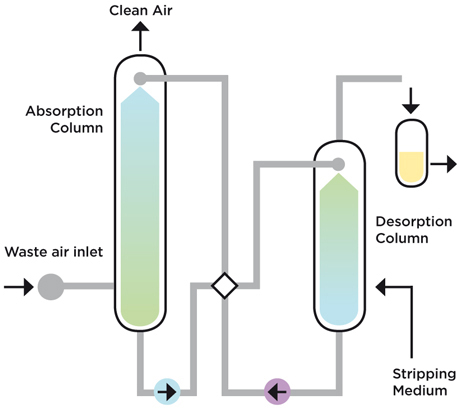
  1. AbsorptionGaseous pollutants that are soluble in aqueous liquids can be removed by absorption. Absorption is one of the main mechanisms used for the removal of acid gas compounds. (Ex: Sulphur dioxide, Hydrogen Chloride and Hydrogen Fluoride) Water soluble organic compounds like alcohols, aldehydes and organic acids can also be removed by absorption. 
    • The contaminant gas or vapour is absorbed from the gas stream as it comes in contact with the liquid
    • All absorption processes operate best when gas and liquid temperatures are low.
    • Gas and vapour phase contaminants are most soluble in cold conditions.
The figure below illustrates the removal of pollutants from a gas stream using a scrubbing liquid. This technique explains the removal of gaseous pollutant by absorption

Water can be used for recovery of water-soluble compounds such
as acetone and low molecular weight alcohols, which can later be separated from water using distillation. Additives are often used to increase the effective mass transfer rate of the pollutant from the gas phase into the liquid phase, affecting the surface tension, reducing interfacial resistance and increasing the apparent solubility.

Gas absorption can be expensive, however it is generally used only to recover VOCs that have a secondary market value. Gas absorption techniques are used for the recovery of a variety of chemicals in the coke manufacturing industry. They are often called scrubbers.

2.   Condensation: Condensation and gas absorption are most commonly used for highly concentrated VOC (Volatile Organic Carbon) streams that are advantageous to recover and the relatively large expense is justified. It employs a drop in temperature and/ or increase in pressure to cause the VOCs in the emission stream to condense. The cleaned air stream is separated from the condensate containing target pollutants. In many cases, very large temperature drops are required to achieve effective condensation, requiring significant energy investment to accomplish cooling.

Condensation is used to recover gasoline and fuel vapors at gasoline loading terminals and in gasoline dispensing facilities. It is also used in the adsorbent regeneration process to separate solvents from the stream to separate solvents from the stream used to regenerate the activated carbon.

3.   Combustion: Incineration or combustion is a commonly used technology to control VOCs. Complete combustion of hydrocarbons produces carbon dioxide and water. Flares, thermal oxidisers and catalytic converters use oxidation chemistry to treat VOC emissions. For example, by using catalytic converters, thermal oxidation of by-products of incomplete combustion can be safely achieved at temperatures much lower than what would be required without the aid of catalysts. Sometimes the gases are moved over a bed of copper oxide, which reacts with oxides of sulphur to form copper sulphate. Copper sulphate acts as a catalyst for reducing NOx to ammonia (NH3). Ammonia may be added to flue gas before passing it over a catalyst. The catalyst enables ammonia to react with Oxides of Nitrogen (NOx) converting it into molecular nitrogen and water. Staged combustion processes significantly reduce NOx emissions

Stack sampling and analysis of air pollutants


STACK SAMPLING AND ANALYSIS OF AIR POLLUTANTS
Stack sampling poses a problem due to the varying composition of pollutants in the flue gas thereby making the process of obtaining a representative sample difficult. The important factors in obtaining a representative sample are:
  • selection of the sampling site and
  • number of sampling points required
  • The sampling site should be located at least eight stack or duct diameters downstream and tro diameters upstream from any source of flow disturbance such as bends, fittings or constrictions. The gas stream in a stack is normally under turbulent flow conditions and any flow disturbance causes non-uniform and unstable gas flow profiles along with non-uniform particle concentration patterns.
The above problems can be minimized by providing proper distance so that adequate mixing may occur. Sometimes it is not possible to ensure uniform flow. Hence, multiple samples are used to acquire a representative sample.
  • Actual sampling must be performed at a number of points in the stack.
  • Two sets of reading, at right angles should be taken at the same plane for circular stacks.
  • The traverse points required is at least six or the number of points depends on location of upstream and downstream disturbances.
  • For rectangular stacks, the sampling site is located by calculating the equivalent diameter using the equation: Deq = 4 * Cross-sectional area of flow / Wetted perimeter

Other problems associated with stack sampling are:
  • High temperature
  • Collection of additional parameters like
    • moisture content
    • pressure
    • temperature
    • flow rate of gas
    • composition of flue gas
Accurate measurements of ALL these factors is essential for valid sampling.
Stack sampling is carried out by diverting part of the gas stream through a sampling train. The sampling train consists of a nozzle, a sampling probe, particulate collection devices, a flow measuring device and a prime mover such as a vaccum pump or an ejector.
The devices used for collection of particulates in gases in stack sampling are:
  • Filtration devices
  • Devices for wet or dry impingement
  • Devices for impaction, electrostatic and thermal precipitation
  • Devices for collecting particulates
  • Adsorption, Absorption and freeze-out devices for collecting gases.
The technique used for sampling particulate laden gases is called “isokinetic technique”. Under isokinetic conditions, the static pressure at the tip of the probe is equal to the static pressure in the free stream and hence the sampling velocity is equal to the free stream velocity. Under these conditions, the flow pattern in front of the probe is not disturbed.
The process for obtaining a gas sample from a stack is similar to that used in sampling particulates. However, the sampling is easier as it is not necessary to sample under isokinetic conditions.
  • Gas sample is withdrawn from stack at a constant rate independent of the flow rate in the stack.
  • Precautions to be followed in gas sampling are as follows:
    • Particulate matter must be filtered upstream of collection system to:
      • prevent downstream line plugging
      • minimize loss of gaseous pollutants due to reaction with particulates on cooling
  • To minimize amount of particulates that are pulled into sampling line, the probe must be pointed downstream.
  • If a straight probe is used, it should be fitted with a filter such as glass or pyrex wool.
  • Moisture present in stack gases can condense in the sampling line and dissolve gaseous constituents of interest.
  • To prevent losses due to condensation the sampling line should be heated.
  • The preferred material for the probe is usually stainless steel and teflon is preferred in some special applications.
  • The rate and duration of sampling are important in determining the amount of constituent gas collected and it depends on the technique used for collection.

ANALYSIS OF AIR POLLUTANTS
  • Air quality measurements are done by continuous automatic analysers.
  • Conventional laboratory techniques for for analysis of discrete samples is done for spot checking.
  • For measurement of gaseous pollutants procedures are physical and chemical principles of measurement
  • In chemical methods, the pollutant being measured undergoes chemical transformation and the product is analysed using an appropriate chemical technique.
    • In wet chemical analysis, the chemical is absorbed in a liquid for a specific time and then treated with a reagent causing a formation of another product indicated by a change of colour. The intensity of colour is related to the concentration of the original pollutant.
  • In physical methods of measurement, a physical property of the pollutant is exploited – such as the ability of the gas to absorb infrared radiation. Its concentration is given by amount of radiation absorbed.
SO2
  • The most common methods for measuring atmospheric SO2 are based on colorimetry, iodimetry or turbidimetry.
  • The West and Gaeke colorimetric procedure is the reference or standard method. In this method, SO2 from a measured quantity of air is absorbed in a solution of sodium tetrachloromercurate. This forms stable and non-volatile dichlorosulphitomercurate complex. This is reacted with formaldehyde and para-rosaniline to yield a magenta coloured para-rosaniline sulphonic acid product. Photometric methods are used to detect the colour intensity of this acid. This is proportional to the concentration of SO2. EDTA is added to prevent interferences due to Iron and other heavy metals.
  • The automatic instruments for monitoring sulphur dioxide are based on conductometric, colourimetric and flame photometric principles. In the conductometric method the sampled air containing SO2 is passed through a dilute solution of H2O2 and dilute sulphuric acid. SO2 is oxidised to H2SO4 with an increase in electrical conductivity of the solution which is proportional to the concentration od SO2 in the sample. However, acidic gases like HCl give positive errors while NH3 interferes negatively.
  • Coulometry is used for automatic monitoring of SO2. In this process, SO2 is drawn continuously through an electrolytic cell containing and acidified bromine solution and two sets of electrodes. SO2 in the air sample is oxidised by bromine causing a reduction in the concentration of bromine. This causes a potential difference between the indicator electrode and the reference electrode. The current flow is a measurement of the SO2 concentration in the air stream.
  • Flame photometric analyser works on the principle that when an air stream containing sulphur is ignited in a hydrogen rich flame, a characteristic flame emission spectrum is produced at 394 μm. This wavelength is monitored by a narrow band pass filter and a photomultiplier tube. The amount of light emitted is proportional to concentration of sulphur within the flame.
  • In the electrochemical method, the SO2 gas diffuses through a semi permeable membrane and a thin electrolyte layer to get absorbed at the sensing electrode where it undergoes an electrochemical reaction. The current generated is proportional to the SO2 concentration. Electrochemical analysers are sensitive and stable for SO2 monitoring. Moreover, they are simple, portable, have a low cost and give immediate results.
  • Infrared and ultraviolet spectrophotometry are based on selective absorption of light at a given wavelength by SO2. Degree of absorption is proportional to SO2 concentration.
  • Spectrophotometric analysers
    • require small particle filtration
    • water removal
    • removal of sulphuric acid mist
    • are bulky and difficult to transport
Because of the above reasons, spectrophotometric analysers are least advantageous for field application.

Methods of air pollution control - zoning, source correction

METHODS OF AIR POLLUTION CONTROL – SOURCE CORRECTION
To effectively tackle the problem of air pollution, it is essential to prevent or minimize the formation of pollutants at the source.In case of industrial pollution, this can be achieved by analysing the process design amd selecting those methods that do not contribute to air pollution or have minimum impact due to air pollution. This technique is known as 'source correction methods'. The application of these methods is difficult, however some of these methods can be applied without having a major impact on economy of operation.
Below described are a few methods for control of pollution at source.
  1. Raw material change – When raw material causes air pollution, a purer grade of raw material may reduce generation of undesirable substances. 
    • An example in this regard is the use of low sulphur diesel in place of regular diesel which contains a higher sulphur content leading to effluents with a high concentration of sulphur particulates. 
    • Another example would be usage of natural gas in place of coal to reduce the generation of particulates (both suspended and respirable).
    • Desulphurization of fuel is an alternative, however it is expensive and poses technical problems. Another problem is lack of availability of better alternatives and the cost involved. 
    • Coal combustion can be carried out with least air pollution by coal gasification. Coal gasification can be carried out by destructive distillation of coal or gasification of coke residues of carbonization with steam. 
2.  Operational change

  • By causing all dust creating activities that are generated in a process to be effectively controlled and separated by effecting an operational change in the manufacturing industry
  • Moistening the dust thereby binding the dust is a time old method to prevent dust from spreading.

3.  Modification or replacement of process equipment – This involves use  of new or modified techniques to lower emission of atmospheric pollutants.

  • An effective method to control dust in industries is by casing all dust creating activities               and the dust generated can be effectively controlled and separated.

  • Moistening the powder in order to bind the dust is an old method prevent dust from                    spreading
  •      Examples are listed below:
    • Unburnt carbon monoxide (CO) and hydrocarbons (HCs) from cylinders of an automobile engine can be burnt by injecting air into the hot exhaust manifold of the engine.
    • Hydrocarbons (HCs) released into the atmosphere from petroleum storage tanks due to temperature changes, direct vapourization and displacement due to filling can be reduced by designing tanks with floating roof covers or pressurising the tanks.
    • Replacing the open hearth furnace by oxygen furnace in steel industries helps in reducing air pollution
    • Alternate power for automobiles (Ex: Hydrogen power, Solar power) in place of internal combustion engines that use fossil fuels will help in significant reduction of air pollution.
    • Air pollution due to industries can be reduced by proper maintenance of equipment, housekeeping and cleanliness of facilities helps reduce air pollution.
    • Ore handling operations result in emission of large quantities of dust. In steel industries, raw ore is replaced with sintered pelletized ore to reduce dust emissions and blast furnace “slips”
    4.   Effective operation of existing equipment
    • Preventing leakage around ducts, piping and valves by checking seals and gaskets regularly air pollution from industries can be minimized.
                                      METHODS OF AIR POLLUTION CONTROL – ZONING

    Air pollution control by zoning:
    The CPCB (Central Pollution Control Board) has developed a tool for environmental planning for proper siting of industries thereby reducing the risks due to pollution and protect the environment. The CPCB in consultation with the SPCBs (State Pollution Control Boards) has developed a zoning atlas for siting of industries based on environmental considerations, district-wise, through-out the country. The zoning atlas for siting of industrial zones, classifies the environment in a region and presents the pollution receiving potential of various locations along with possible alternate sites through easy-to-read maps. The objectives for preparing the zoning atlas are:
    1. To zone and classify regions
    2. To identify locations for siting of industries and
    3. To identify industries suitable for identified sites

    The zoning atlas considers only environmental aspects. The zoning atlas helps in stream-lining the decision-making process along with the following benefits:

    • It provides a ready-reckoner for best suitable site and relevant environmental information
    • It helps to make decisions that are simple, faster, realistic, transparent and reliable
    • It provides a basis for incorporating environmental aspects into land use planning
    • It helps to plan for cost effective pollution control measures and programs
    • It helps an entrepreneur save money, time, efforts and risk
    • Helps develop infrastructural facilities
    • It helps check additional pollution in areas already stressed with pollution
    • It ensures that pollution potential of an industry is compatible with local conditions
    • It ensures that industries with high pollution potential that are desirous to locate an industry in a high risk area adopts clean technologies so that generation of wastes is prevented or made compatible with the receiving environment.
    • Helps in creating awareness among people regarding type of industries and nature of pollution anticipated in their neighbourhood
    • In view of all the above mentioned issues, an EIA helps achieve sustainable development.

    Selection of proper air pollution control equipment

    Selection of a particular air pollution control device greatly depends on:
    1. Particle size
    2. Concentration
    3. Desired efficiency of collection
    4. Cost involved
    5. Availability of space
    6. Maintenance factors

    Stack height calculation